

Bluebell
nêhiyawêwin (Cree): ogu-malask ("king's plant")<br /> Latin: <i>Mertensia paniculata </i> <br/> Lungwort, Northern blue bell, Chiming bell, tall bluebell
By Naomi Taoubi(Banner image) USask [CC BY-SA]
Description

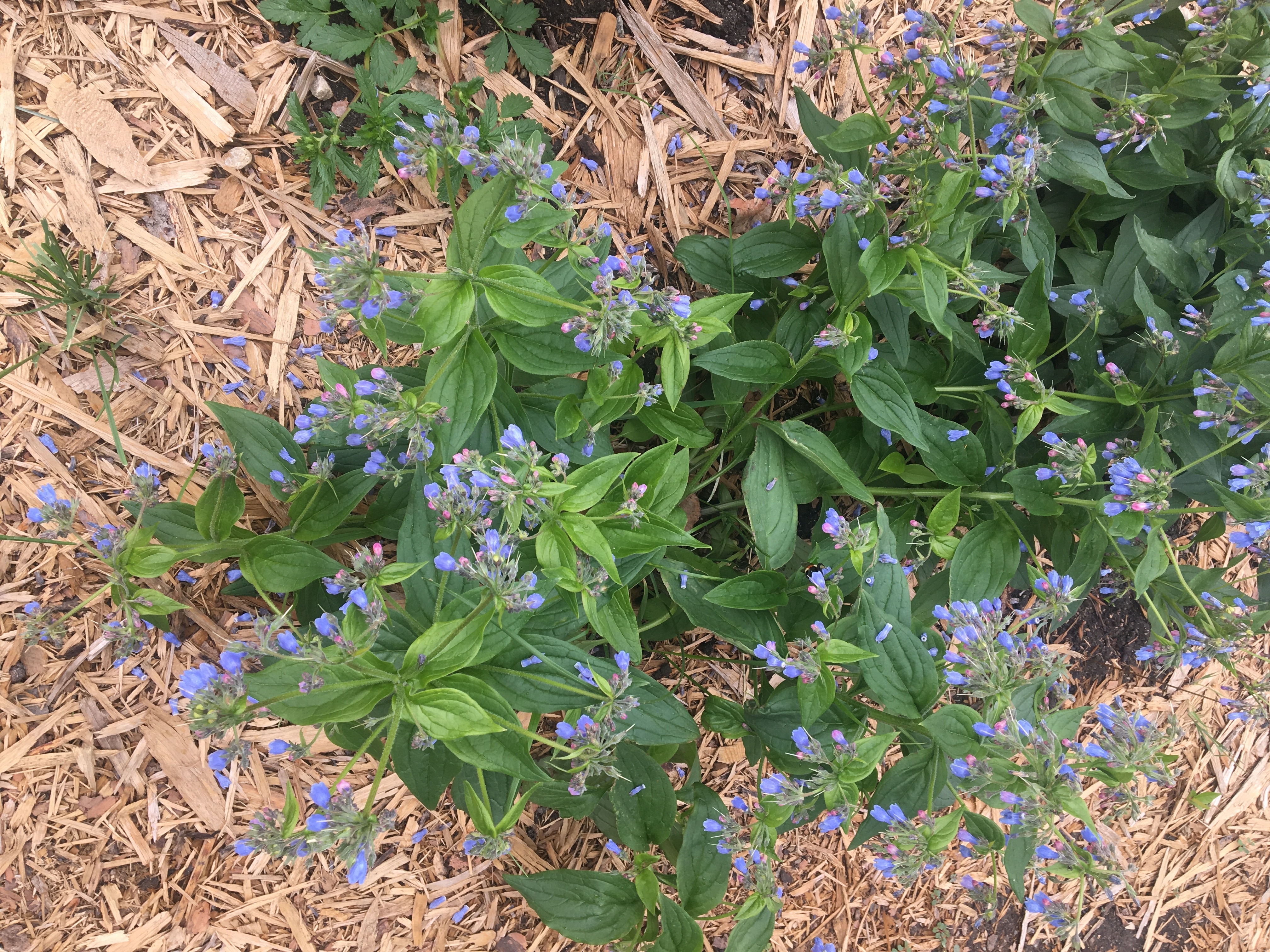
There are many types of blue bells. The type in our garden is known as Lungwort, king's plant, and chiming bells. Its leaves are quite large. Maria told us to plant them in groups of about five because that's how they grow in the wild. She used to gather them for her grandmother when she was a little girl. (Campbell, 2018) We planted some around the circle gathering place, at shoulder level at the brick wall.
Another type of Bluebell that is popular but not in our garden is Harebell which has slender leaves and is more grasssy-looking. Harebell's name in nêhiyawêwin (Cree) is kaskwȃsonȃpiskos ("thimble plant") and its Latin name is Campanula rotundifolia L. Harebell is also known as Scottish Bluebell (McHaffie, 2013).
Yet a third type of Bluebell is also called Wild Hyacinth and its Latin name is Hyacinthoides non-scripta (McHaffie, 2013). This one is known for growing in the woods and is an ‘indicator species’ to identify European ancient woodland due to its' roots ability to penetrate thick layers of leaf litter (Wikipedia, n.d.).
- Is a perennial bulb, growing from black seeds that germinate on the soil surface
- Has violet-blue petals in spring – May/June
- Has cream-coloured pollen that bumblebees and others are attracted to
- Is strongly and sweetly scented
- Normally likes partial shade and prefers slightly acidic soil; though it prefers to grow under a canopy, it can also be found in fields and meadows in drier, rocky, hilly, sandy soil
- Does well in herbaceous areas
- Has 15 biologically active compounds that protect them against insects and animals
- Has certain water soluble alkaloids (extracts) similar to compounds tested for use in combatting HIV and cancer
- Can be found alongside lily of the valley, day lilies, ferns, primrose
Medicine
respiratory system, coughs, diarrhea, hemorrhoids, heal tissue, mend bones

Lungwort is good for coughs because it stimulates the respiratory system. It can also releive diarrhea and hemorrhoids because it's an astringent (Gray, p. 116). An astringent plant causes cells to contract.
It shares something in common with Comfrey; both contain allantoin which gives comfrey its name 'knitbone'. It helps to heal tissue and mend bones. (Gray, p. 116)
Lungwort is one of the ingredients in a compund medicine for heart trouble (Métis Elder in Marles, p. 151).
The Harebell (Scottish Bluebell) bulbs and roots are dug up and dried for use (Mikisew Cree First Nation, n.d.). Medicinal applications of Harebell include: leucorrhoea (chemical imbalance in women, common in pregnancy, to help increase estrogen), the bulbs as a diuretic (to flush out the system, treat flu, heart failure, kidney diseases, hypertension, water poisoning, liver cirrhosis and to flush out overdoses such as too much aspirin), as a styptic/anti-hemorrhagic/hemostatic agent (to promote hemostatis), and as an adhesive (sap of the plant). ("Hyacinthoides non-scripta", Wikipedia)
Food
You can eat the leaves. Enjoy them raw in a salad, steamed, or added to soup or stew. (Gray, p. 116)
The leaves can also be dried and mixed with tobacco for smoking. (Lamont as cited in Marles, p. 151)
References
(Banner image) "Bluebells in the traditional garden". University of Saskatchewan. [CC BY-SA (https://creativecommons.org/licenses/by-sa/3.0)]
"Blue Harebell". (n.d.) Retrieved from University of Alberta Indigenous Teaching & Learning Gardens website: https://sites.google.com/a/ualberta.ca/our-garden/our-plants/blue-harebell
Campbell, Maria., Métis Cultural Advisor. Treaty 6 territory. Saskatoon SK. USask Traditional Garden workshop. Personal communication. June 20, 2018.
Campanula rotundifolia (Bluebell). (n.d.). Retrieved from Gardenia website: https://www.gardenia.net/plant/Campanula-rotundifolia-Bluebell
Gray, B. (2011). The Boreal Herbal - Wild Food and Medicine Plants of the North - A Guide to Harvesting, Preserving, and Preparing. Whitehorse, Yukon: Aroma Borealis Press, co-published by CCI Press, Canadian Circumpolar Institute, University of Alberta. http://borealherbal.com
Hyacinthoides non-scripta. (n.d.). In Wikipedia. Retrieved from https://en.wikipedia.org/wiki/Hyacinthoides_non-scripta
Marles, R. J., Clavelle, C., Monteleone, L., Tays, N., and Burns, D. (2012). Aboriginal Plant Use in Canada's Northwest Boreal Forest. Edmonton, AB: Natural Resources Canada.
McHaffie, H. (November 21, 2013). The Bluebell Debate. Retrieved from Royal Botanic Garden Edinburgh website: https://stories.rbge.org.uk/archives/6928
Mertensia paniculata. (n.d.) In Wikipedia. Retrieved from https://en.wikipedia.org/wiki/Mertensia_paniculata
Mikisew Cree First Nation, Centre for Indigenous Environmental Resources. (n.d.). Sagow Pimachiwin: Plants and Animals used by Mikisew Cree First Nation for Food, Medicine and Materials. [PDF]. Retrieved November 2018, from www.yourcier.org/uploads/2/5/6/1/25611440/sagow_pimachiwin_guidebook.pdf