

Sage
nêhiyawêwin (Cree): mostosowehkuskwa ("good tasting cow plant") Anishinaabemowin / Ojibwe: Sukodawabuk Michif / Métis: l'aarbr a saent Blackfoot: Kaksamis Latin: Artemisia ludoviciana (prairie sage), Artemisia frigida (pasture sage, female sage), Artemisia tilesii (stinkgrass, mugwort) Common names: White sage, Wormwood, Fringed Sagewort, Pasture sage
By Ashleigh Androsoff(Banner image) USask [CC BY-SA]
Description
There are many sage varieties. It is important to know the difference between Artemisia ludoviciana and Salvia officinalis. Both are very useful. The one of ceremonial significance for Indigenous peoples is Artemisia ludoviciana. The one many people cook with is Salvia officinalis.
Artemisia ludoviciana (prairie sage, white sage) is native to North America. It grows and spreads quickly. It is a perennial and gives small yellow-grey flowers. It grows well in poor, dry soil with full sun and requires good drainage. It grows to be between two and three feet tall. Sage can survive hot weather, drought, and cold weather (to -20 degrees Celcius). It attracts butterflies, and resists deer and rabbits (Gardenia, n.d.). It is important to be thoughtful when planting any of the four sacred medicines: they should be grown organically, away from pollutants, and away from heavy traffic.
Salvia officinalis– the kitchen and culinary variety of sage – is related to mint. It is perennial and evergreen; its stems are woody, and its leaves are grey-green. Its flowers are blue or purple. The designation “officinalis” is an indication that the plant is recognized for its medicinal and culinary utility and ubiquity.
Like prairie sage, other members of the Aster family include Black-Eyed Susan, Chamomile, Coneflower, Fringed Aster, Goldenrod, Smooth Aster, and Yarrow.
Medicine
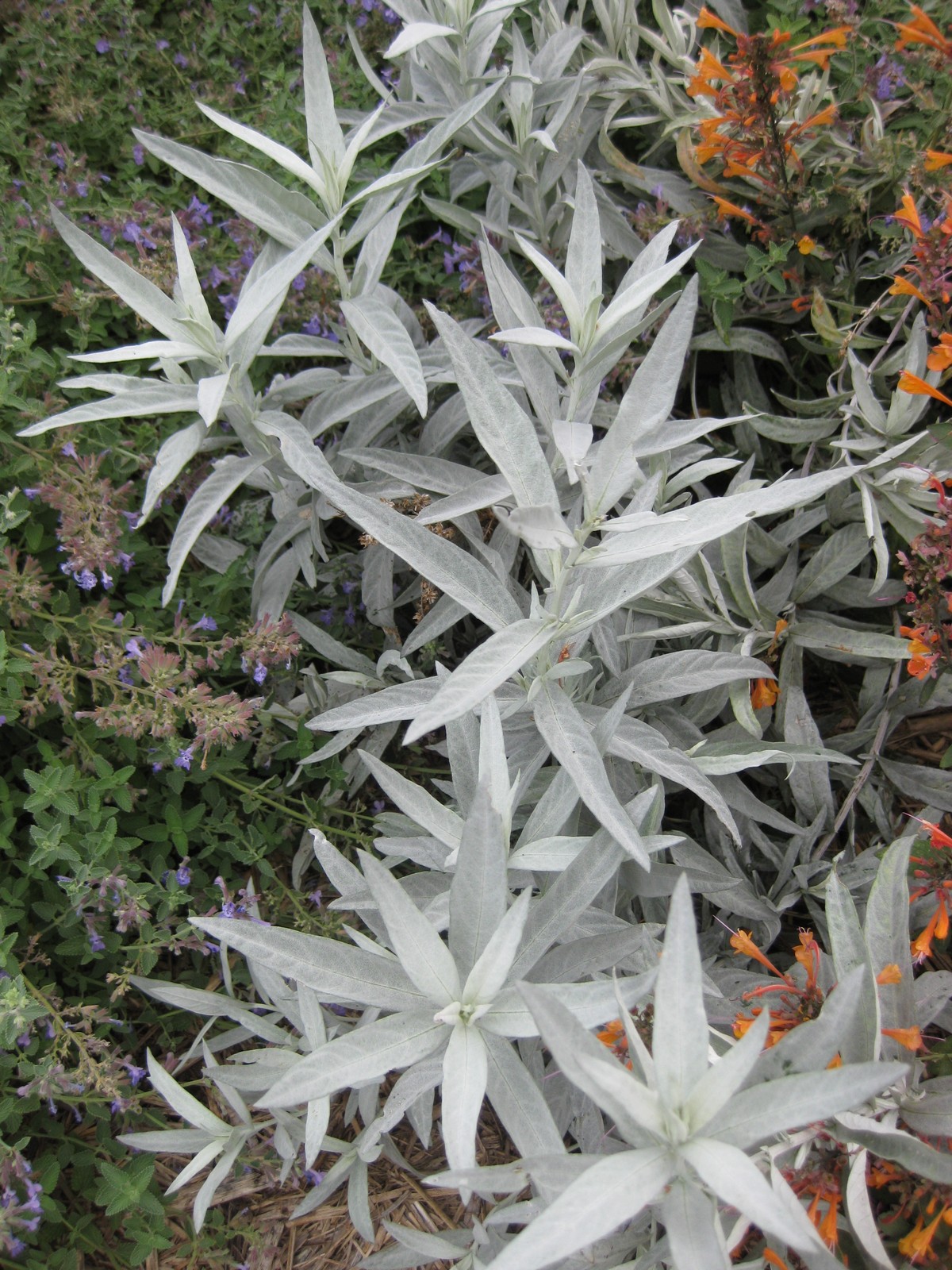
Sage has been labelled as "a medicine to cure all ills" (Six Nations, n.d.). When steeped in a tea, sage guides women towards their moon time; therefore, it should not be consumed as a tea during pregnancy, or when breast feeding (it could interfere with milk production). It may be used to reduce symptoms of menopause (hot flashes).
If you wait too long to harvest the leaves for tea, they will be bitter. Young sage leaves make less bitter tea.
Sage leaves can be applied to wounds and has antiseptic properties; it can be chewed to relieve sores in the mouth, and can be effective against sore throats, colds, and flu. Cheyenne people crushed leaves to use as a snuff to relief sinus trouble, nosebleeds, and for headaches; Crow people mixed crushed sage with fat to apply as a salve on sores (White Sage, n.d.).
The name 'wormwood' comes from the use of sage to expel worms by drinking the sage in a warm tea. It may also help improve appetite and digestion. (Gray, p. 151-2)
Sage can be used for digestive issues (lack of appetite, gas, bloating, stomach pain, diarrhea), for high cholesterol, and for mental health issues (depression, loss of memory, Alzheimer’s) (WebMD, n.d.).
To reduce scars as burns are healing, one can use a poultice of boiled sage leaves (Cree Elderin Marles et al, p. 122).
When hiking, relieve sore feet by lining the bottom of your shoes with wild sage leaves. When you get home, add the leaves to a hot bath or massage oil to relieve tension in sore muscles (Gray, p. 152).
Caution: contains thujone, which can cause seizures if taken in high amounts.
Spiritual Use
Sage is one of the four sacred medicines, along with tobacco, cedar, and sweetgrass. Sage smudge is used for the spiritual cleansing of people, places, things and is often used during ceremony (including Sun / Thirst Dance): it is a good treatment for removing negative spirit and making room for positive spirit. Before lighting the sage, a window or door should be opened to give the negative energy a way to move on. If a flame results when the sage is lit, one can wave it out with the hand or a feather; one should not blow out the flame with one’s breath. The smoking sage can be put in a fireproof and natural vessel (abalone shell, a curved rock, or pottery). One “washes” with sage smoke: the smoke is moved over the person, place, or thing being cleansed. When smudging the body with sage smoke, the person focuses on cleansing the mind making room for good thoughts, cleansing the eyes for clearer sight, cleansing the ears for clearer hearing, cleansing the mouth for kinder speech, and the body to move through the world in a better way (Smudging Protocol and Guidelines, 2018). After smudging, the ashes should be placed outside on the ground in a quiet place (Smudging 101, 2013). Anishanaabe teachings tell us that this is woman’s medicine, and can be handled by women whether menstruating or not (whereas other medicines, like tobacco, are restricted during women’s moon time). It is understood by Haudenosaunee and Anishinaabe to be in the western door, but the placement may differ from community to community (The Medicines, n.d.) One can smudge daily with sage smoke, but smudging should always be practiced with respect and in a good way (Four Sacred Plants, 2011).
Harvest
It has been said that in a patch of prairie sage, the tall plants with more seeds are the masculine plants, and the shorter plants with buds are feminine plants.
The female plants don't have any leaves, mainly seeds, and grow in a circle.
Food
The leaves of salvia officinialis are rich in vitamins and minerals, particularly calcium, potassium, vitamin B1, and zinc. (WebMD, n.d.)
You can add the leaves to salads or stuffing with wild cranberries (Gray, p. 153).
Other use
For insect repellant, rub the leaves on your skin (Cree Elder, Métis Elder in Marles et al., p. 122). Sage smoke can also repel mosquitoes. Métis people would burn a smudge fire near the place where horses are tied up to keep the bugs off (Plants Growing Along teh Riber, Fringed sage, Pasture sage).
It can be used as a deodorant when taken as a tea, or applied to the skin as a tincture.
To freshen breath, the leaves can be chewed (Cree Elder, in Marles et al., p. 122).
Pasture sage is one of the ingredients of a smoking mixture called kinnikinnick which is also made with bearberry and Labrador tea (Gray, p. 151).
References
(Banner image) "Sage plants in the traditional garden". University of Saskatchewan. [CC BY-SA (https://creativecommons.org/licenses/by-sa/3.0)]
Cree Elder, Northwestern Alberta region, AB. Interviewed 1994-5, published in Marles et al., 2012.
Cree Medicine. (n.d.) Retrieved from nehiyawewin.ca website: http://nehiyawewin.ca/cree-medicine3/#S
Four Sacred Plants. (June 27, 2011). Retrieved from anishinaabemowin website: http://anishinaabemodaa.com/lessons?lesson_id=94
Gardenia. (n.d.) Artemisia ludoviciana (White Sage). Retrived from Gardenia website: https://www.gardenia.net/plant/artemisia-ludoviciana-white-sage
Gray, B. (2011). The Boreal Herbal - Wild Food and Medicine Plants of the North - A Guide to Harvesting, Preserving, and Preparing. Whitehorse, Yukon: Aroma Borealis Press, co-published by CCI Press, Canadian Circumpolar Institute, University of Alberta. http://borealherbal.com
Government of Manitoba. (2018). Smudging Protocol and Guidelines for School Divisions. Retrieved from https://www.edu.gov.mb.ca/aed/publications/pdf/smudging_guidelines.pdf.
Heritage Michif Dictionary. (n.d.) Retrieved from Gabriel Dumont Institute of Native Studies and Applied Research website: http://www.metismuseum.ca/michif_tools.php
Kainai Ecosystem Protection Association; Yellowstone to Yukon Conservation Initiative. (2020). "Naapi’s Garden: A guide to culturally important Blackfoot Plants" [Pamphlet]. BuffaloTreaty.com https://www.buffalotreaty.com/flux/naapis-garden-a-guide-to-culturally-important-blackfoot-plants
Manitobah Blog. (September 11, 2013). Smudging 101: Four Aboriginal Medicines. Retrieved from https://blog.manitobah.ca/2013/09/11/four-aboriginal-medicines/
Métis Elder, Elizabeth Métis Settlement, Alberta. Interviewed 1994, published in Marles et al., 2012.
Marles, R. J., Clavelle, C., Monteleone, L., Tays, N., and Burns, D. (2012). Aboriginal Plant Use in Canada's Northwest Boreal Forest. Edmonton, AB: Natural Resources Canada.
Plants Growing Along the River: lii plante kaa shaakikihki oborr la rivyayr (2019) [Plant guide]. Saskatoon, SK: Gabriel Dumont Institute. https://gdins.org/product/plant-guide/
Prarie Sage. (n.d.) Retrieved from Univeristy of Alberta Indigenous Teaching & Learning Gardens website: https://sites.google.com/a/ualberta.ca/our-garden/our-plants/prairie-sage
Sage. (n.d.) Retrieved from WebMD website: https://www.webmd.com/vitamins/ai/ingredientmono-504/sage
Six Nations of the Grand River Development Corporation. (n.d.) The Medicines. Retrieved from http://oursustenance.ca/gardening-101/the-medicines/
Teachings & Traditions: The Four Sacred Medicines + Smudging Ceremony. (March 14, 2018) Retrieved from A Tribe Called Beauty website: https://atribecalledbeauty.wordpress.com/2018/03/14/teachings-traditions-the-four-sacred-medicines-smudging-ceremony/
Vitality TV. (Feb 7, 2010). Picking Sage and Great Advice from an Elder [Video]. Retrieved from https://www.youtube.com/watch?time_continue=1&v=zzysDb4pVco
White Sage. (n.d.) Retrieved from United States Department of Agriculture Natural Resources Conservation Services website: https://plants.usda.gov/plantguide/pdf/cs_arlu.pdf
