

Brown/Black-Eyed Susan
Latin: <i>Rudbeckia hirta L. </i>, <i>Gaillardia aristata</i><br/>
By Nancy Turner(Banner image) USask [CC BY-SA]
This plant likes lots of sun light and moderately dry soil. It does not like wet areas. It grows on the Great Plains of North America. It is a quite aggressive plant so often does not have many other flowers around it.
Like Brown-Eyed Susan, other members of the Aster family include Chamomile, Coneflower, Fringed Aster, Goldenrod, Ox-eye daisy, Sage, Smooth Aster, and Yarrow.

Neighbouring plants and bugs

Attracts bees, butterflies and other insects drawn to the nectar.
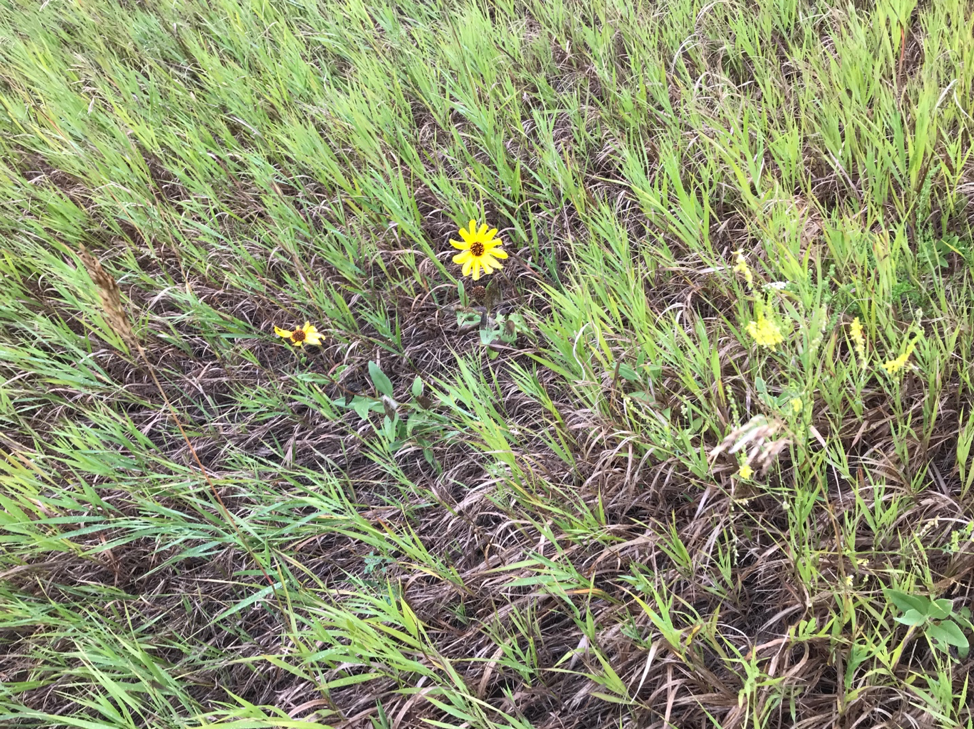
In the wild, plants that have been seen growing near Black-Eyed Susans include Goldenrod and Fringed Aster. The Goldenrod and Aster below were seen growing less than 10 feet away from a Black-Eyed Susan.
 |
 |
Medicine
antioxidant, immune system, colds, flu, infections, snake bites, wash, worms

Certain parts of the plant are known to have antioxidant properties.
The roots can be used to boost immunity – fight colds, flus and infections (often made into tea)
Ojibwa people use it to treat snake bites. So did the Cherokee who would make a root tea and use it as a wash (Foster & Duke, p. 172).
The Iroquois used the root tea for worms in children (Foster & Duke, p. 172).
Usage

The petals can be used for dye.
Métis children would pick all kinds of flowers and would listen to Mooshoom to learn what is safe to eat. (Plants Growing Along the River, Gaillardia)
References
(Banner image) "Brown-eyed Susans in the traditional garden". University of Saskatchewan. [CC BY-SA (https://creativecommons.org/licenses/by-sa/3.0)]
Native Prairie Society of Saskatchewan. (Accessed Dec. 2019). Field Guide: Black-Eyed Susan. Retrieved from https://www.npss.sk.ca/games/?p=look-up&id=62
Foster, S. and Duke, J. A. (2014). Peterson Field Guide to Medicinal Plants and Herbs of Eastern and Central North America, Third Edition. New York: Houghton Mifflin Harcourt Publishing Company.
Plants Growing Along the River: lii plante kaa shaakikihki oborr la rivyayr (2019) [Plant guide]. Saskatoon, SK: Gabriel Dumont Institute. https://gdins.org/product/plant-guide/