

Celery (Wild)
nêhiyawêwin (Cree): kaspipakwa ("celery")<br/> Latin: <i>Apium graveolens</i>, <i>Angelica lucida</i> L.<br/> Angelica, Wolverine rhubarb
Description
Also known as Angelica, comes from the Latin "angelus" which means angel, because of the many medicinal properties of this plant and / or liquor obtained from it, and "archiatra" meaning "head doctor". (Properties of Wild Celery, n.d.).
Wild celery is a strong-smelling biennial growing up to 3 ft (1m). It has finely divided leaves; the late summer flowers are held in loose compound umbels.
This plant usually grows along the coast, both Pacific and Atlantic (Marles et al., p. 103). Easily grown in rich, slightly acidic, medium to wet soils in full sun to part shade. Full sun in northern areas. (Angelica archangelica, n.d.).

Growth
Usage
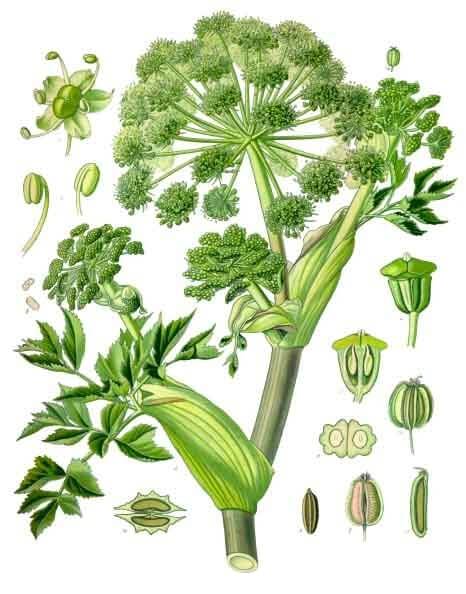
Different kinds of wild celery have different medicinal properties, including carminative, aperitif, digestive; for bad blood circulation; rheumatic diseases; psoriasis; febrifuge; nerve disorders; diseases of the respiratory tract and others. The roots could be used in the treatment of epilepsy.
lt produces tall sturdy hollow stacks with a licorice flavour, which can be steamed or candied for baking (Brother Nature Certified Organic Seeds, 2019).
Provides a habitat for Swallowtail Butterfly larvae and adult pollen feeders. Fresh leaves could be used in soups, salads and stews. It is also a producer of a deep green dye.
References
Angelica archangelica. (n.d.) Retrieved from Missouri Botanical Garden Plant Finder: https://www.missouribotanicalgarden.org/PlantFinder/PlantFinderDetails.aspx?taxonid=276039
(Banner Image) "Angelica archangelica Wild celery". (2020). [Digital image]. Artisan Aquatics. Retrieved from https://artisanaquatics.co.uk/shop/angelica-archangelica-wild-celery/
Brother Nature Certified Organic Seeds. (2019). Herbs: Wild Celery (Angelica archangelica). Retrieved from http://www.brothernature.ca/seed.asp?id=358 (Accessed December 2019)
"celery - kaspipakwa". (2004). In Maskwacis Dictionary. Retrieved from nehiyaw mansinahikan Online Cree Dictionary. http://www.creedictionary.com/search/?q=celery&scope=0
Eat the Planet. (2020). Angelica (Wild Celery), Sweet but Hardy. Retrieved from http://eattheplanet.org/angelica-wild-celery-sweet-but-hardy/ (Accessed December 2020)
Flogaus-Faust, R. (2018). "Angelica archangelica 2 RF". [Digital image] CC BY (https://creativecommons.org/licenses/by/4.0) Retrieved from Wikimedia commons, https://commons.wikimedia.org/wiki/File:Angelica_archangelica_2_RF.jpg

Properties of Wild Celery. (n.d.) Retrieved from Botanical-Online: https://www.botanical-online.com/en/medicinal-plants/wild-celery
Marles, R. J., Clavelle, C., Monteleone, L., Tays, N., and Burns, D. (2012). Aboriginal Plant Use in Canada's Northwest Boreal Forest. Edmonton, AB: Natural Resources Canada.