

Fireweed
nêhiyawêwin (Cree): Ithkâpâskwa <br/> Michif-Cree: Eñ narbaazh di feu, bouquets rouge <br/> Île-à-la-Crosse Michif: Wîposkâwiwâpikwanîs<br/> Latin: <i>Chamaenerion angustifolium (L.) Scop.</i> , <i>Epilobium angustifolium</i> L. <br/> Great Willowherb<br/>
By Gift Marufu(Banner image) USask [CC BY-SA]
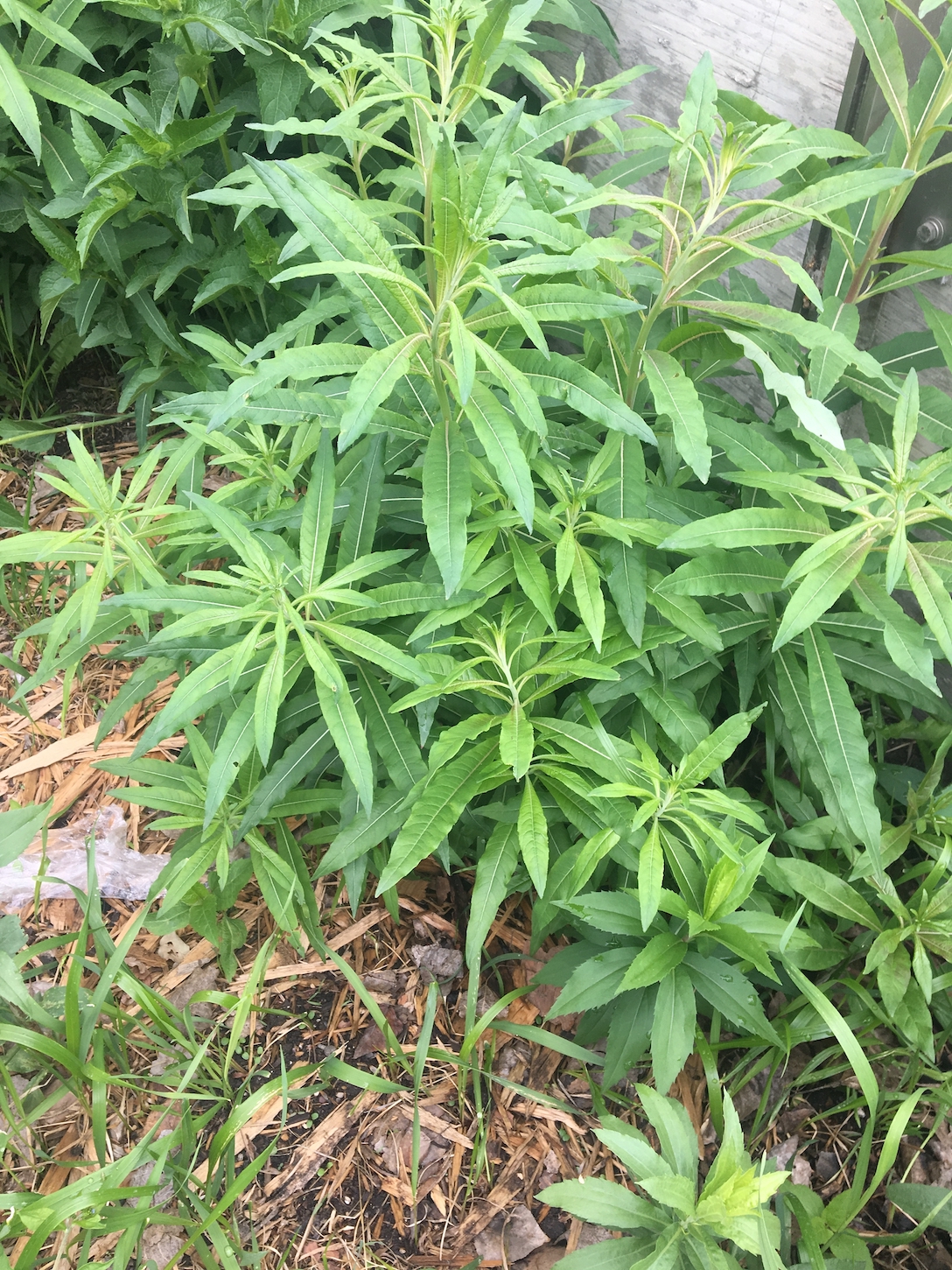
Fireweed earned its name because this plant is the first to grow after forest fires. It's found throughout the temperate northern hemisphere including some areas in the boreal forests.
The roots help to stabilize the soil and reduce erosion while a forest fire area regenerates (Gray, p. 92).
Tall fireweed is found in open woods, on hillsides, on stream banks, and near seashores in arctic regions. It is often abundant in web areas with slightly acidic soils and in open fields and pastures. It is especially abundant in burned-over areas (the seeds stay even after the burnt area reforests itself and germinate after another burn). Dwarf fireweed is found along streams, sandbars, and lakeshores and on alpine and arctic slopes.
Medicine
burns, rashes, skin problems, skin redness, acne, boils, cuts, reducing swelling in ear, nose, and throat, excess mucus, prevent infection of wounds, worms, digestive upsets

The root was peeled and poulticed for burns, rashes, and other skin problems (Foster & Duke, p. 196). Fireweed has been used for skin care to reduce redness and acne because of its anti-inflammatory properties (Gray, p. 93). It is also used in the ear, nose, and throat to reduce swelling. Fireweed is used as an astringent (Keane, p. 40).
Some cultures add Fireweed to their dog food. Can be used to treat boils and cuts by placing a piece of the stem on the infected area.
Fireweed can diminish excess mucus production and accumulation. It has antiseptic compunds to inhibit bacterial growth. Using the root helps to prevent wounds from becoming infected. (Belacourt, p. 25) The leaves can be chewed and applied to bruises, and the roots peeled and chewed and applied to boils to treat or prevent infection (Métis Elder, published in Marles et al, p. 212).
Fireweed tea has been used as a mild laxative for dispelling worms and digestive upsets (Gray, p. 92) such as dysentery, cramps, and "summer bowel troubles" (Foster & Duke, p. 196).
Food

Children pull the flowers off the stem to suck out the nectar. (Belacourt, p. 25) The flowers add bright flavour to tea. You can find some really nice tea blends that include fireweed from Strong Nations (gifts, books & publishing), an Indigenous-owned business in the traditional Snuneymuxw territory around Nanaimo, BC.
The shoots can be cooked like asparagus. The flowers and young leaves can be eaten raw; they're slightly sweet, and very mildly astringent. The leaves, stems, and flowers are edible in the spring but become tough and bitter in summer. You can split open the stems of old plants and eat the pith raw. They are a good source of vitamin C and vitamin A. (Gray, p. 93)
The plant can be boild to make a beverage (Cree Elders, published in Marles et al, p. 211).
Another type of fireweed (Senecio madagascariensis), which has yellow flowers, may be toxic to humans and horses (Colegate, 2008). The fireweed in-flower is the most toxic. When ingested it can be toxic to the liver and neurological system eventually leading to death.
Other
The dried stems have been used for smoking like tobacco (Dene Elder, published in Marles et al, p. 211).
Beaded pins of Fireweed were created during the COVID-19 pandemic and given to frontline healthcare workers. ("Yukon beaders...", 2020)
References

Belacourt, C. (2007). Medicines to Help Us - Traditional Métis Plant Use. Saskatoon, SK: Gabriel Dumont Institute.
(Banner image) "Fireweed bloom". University of Saskatchewan. [CC BY-SA (https://creativecommons.org/licenses/by-sa/3.0)]
Colegate, S. (2008) Fireweed Toxicity: Facts and Perspectives. Retrieved from https://pdfs.semanticscholar.org/6da9/32e5251f6a8cddbcfb9e03d25a1d08e82bed.pdf (Accessed April 2020)
Cree Elders, Nelson House, Manitoba. Interviewed 1994-5, published in Marles et al., 2012.
Dene Elder, Stony Rapids, Saskatchewan. Interviewed 1980-82, published in Marles et al., 2012.
"Fireweed". (n.d.) Retrieved from University of Alberta Indigenous Teaching & Learning Gardens website: https://sites.google.com/a/ualberta.ca/our-garden/our-plants/fireweed
Gray, B. (2011). The Boreal Herbal - Wild Food and Medicine Plants of the North - A Guide to Harvesting, Preserving, and Preparing. Whitehorse, Yukon: Aroma Borealis Press, co-published by CCI Press, Canadian Circumpolar Institute, University of Alberta. http://borealherbal.com
Foster, S. and Duke, J. A. (2014). Peterson Field Guide to Medicinal Plants and Herbs of Eastern and Central North America, Third Edition. New York: Houghton Mifflin Harcourt Publishing Company.
Keane, Kahlee RootWoman. (2013) British Columbia's Wild Medicinal Plants. eBook. Save our Species. https://www.yumpu.com/en/document/read/51452017/british-columbias-wild-medicinal-plants-kahleekeanecom
Marles, R. J., Clavelle, C., Monteleone, L., Tays, N., and Burns, D. (2012). Aboriginal Plant Use in Canada's Northwest Boreal Forest. Edmonton, AB: Natural Resources Canada.
Métis Elder, Elizabeth Métis Settlement, Alberta. Interviewed 1994, published in Marles et al., 2012.
Yukon beaders churn out 'fireweed hero pins' for frontline workers. (2020, May.). CBC News (North). Retrieved from https://www.cbc.ca/news/canada/north/yukon-fireweed-hero-pins-1.5548698