

Ox Eye Daisy
nêhiyawêwin (Cree): pîsimwâpakwaniy ("daisy"), iskwew owehowina<br/> Latin: <i>Leucanthemum vulgare, syn</i>. <i>Chrysanthemum leucanthemum</i><br/>
In the wild
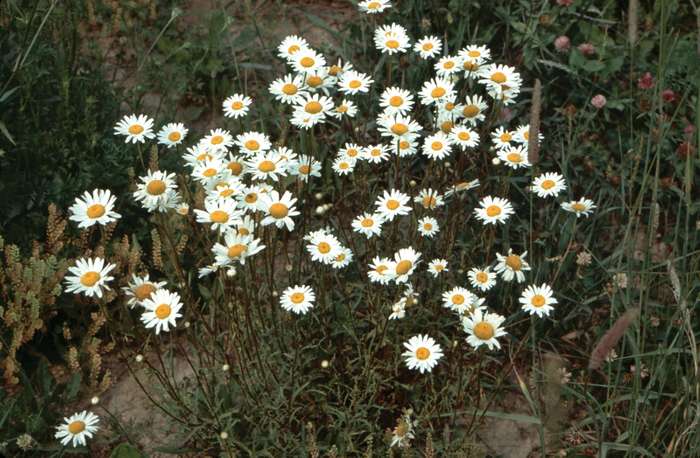
Ox-eye daisy is native of Europe and temperate Asia, but it is freely self-seeding and has become abundantly naturalized in parts of North America, Australia and New Zealand.
It is considered by some to be a harmful invasive species. It decreases forage for wildlife, decreases local plant biodiversity, and may compromise vegetative ground cover due to its growth form that results in exposed soil. (ISCBC, 2019)
Oxeye daisy is a fellow member of the Aster family which includes Black-Eyed Susan, Chamomile, Coneflower, Goldenrod, Sage, Smooth Aster, and Yarrow.
Growth
These plants are largely undemanding, growing well in a perennial border or garden bed in full sun or morning shade in moderately fertile, moist but well-drained soil. It is commonly found along roadsides, in pastures and in disturbed soil all over the place.
Usage
Ox-eye daisies are not a great forage plant for other animals because of the presence of pyrethrum, a naturally occurring pesticide that gives the leaves a bitter taste. Horses, sheep, and goats will eat ox-eye daisy, but cows and pigs avoid it. Young shoots and leaves are edible, but bitter. They may be used sparingly in salads as a bitter herb and digestive tonic. You can use dried ox-eye daisy flowers to make a tea that will clear up sinus congestion for 4 to 6 hours. The flowers are balsamic and make a medicinal infusion for relieving chronic coughs and for bronchial problems. The herb is used in the treatment of whooping cough, asthma and nervous excitability. The root is used successfully for stopping the night-sweats of pulmonary consumption. Externally, it is used as a medicinal lotion for wounds, bruises, and ulcers. A distilled water made from the flowers is an effective eye lotion in the treatment of conjunctivitis (pink eye). (Neverman, 2012)
Medicine
Indigenous people have adopted this plant for use as a tea for fever, a wash for eyes and chapped hands. (Foster & Duke, p. 121)
The ox-eye daisy is considered to have similar effects as chamomile. (Foster & Duke, p. 121) Mixed with other ingredients, it's used in a tea to soothe nerves in adults and hyperactivity in children (Métis Elder, published in Marles et al., p. 127).
References
Brown, D. A. (1978). The encyclopedia botanica : the definitive guide to indoor blossoming and foliage plants. Dial Press.
"daisy - pîsimwâpakwaniy". (2004). In Alberta Elders' Cree Dictionary English-Cree. Retrieved from nehiyaw mansinahikan Online Cree Dictionary. http://www.creedictionary.com/search/?q=daisy&scope=0
Foster, S. and Duke, J. A. (2014). Peterson Field Guide to Medicinal Plants and Herbs of Eastern and Central North America, Third Edition. New York: Houghton Mifflin Harcourt Publishing Company.
(Banner Image) The Eden Project (2019). Retrieved from https://www.edenproject.com/learn/for-everyone/edible-wild-food-ox-eye-daisies. (only personal and non-commercial use of image allowed)
The Invasive Species Council of BC (ISCBC). (Accessed Dec. 2019). Oxeye Daisy. Retrieved from https://bcinvasives.ca/invasive-species/identify/invasive-plants/oxeye-daisy
Marles, R. J., Clavelle, C., Monteleone, L., Tays, N., and Burns, D. (2012). Aboriginal Plant Use in Canada's Northwest Boreal Forest. Edmonton, AB: Natural Resources Canada.
Métis Elder, Elizabeth Métis Settlement, AB. Interviewed 1994, published in Marles et al., 2012.
Neverman, L. (2012) "Ox-eye Daisy, Chrysanthemum leucanthemum – Weekly Weeder #18" by Common Sense Home. Retrieved from https://commonsensehome.com/ww18-oxeye-daisy/