

Tobacco
nêhiyawêwin (Cree): cistimaw Latin: <i>Nicotiana rustica</i><br/>
(Banner image) USask [CC BY-SA]
Description

Even though it was usually women who did agriculture, tobacco was approached differently; it was grown by the old men (Hughes, p. 67).
Tobacco is likely the earliest form of agriculture in North America (Collishaw, 2009). It was grown by the Huron Nation for trade.
Tobbaco loves full sun and doesn't like cold soil. However, it can get distressed from too much heat, which you can help by watering more frequently or moving it (if potted) to a more shared area.
The older leaves will begin to yellow in late August. Yellowing can start sooner if the plant is stressed.
The tobacco family attracts polinators. It also acts as a repellant for other insects because of its nicotine content.
Usage
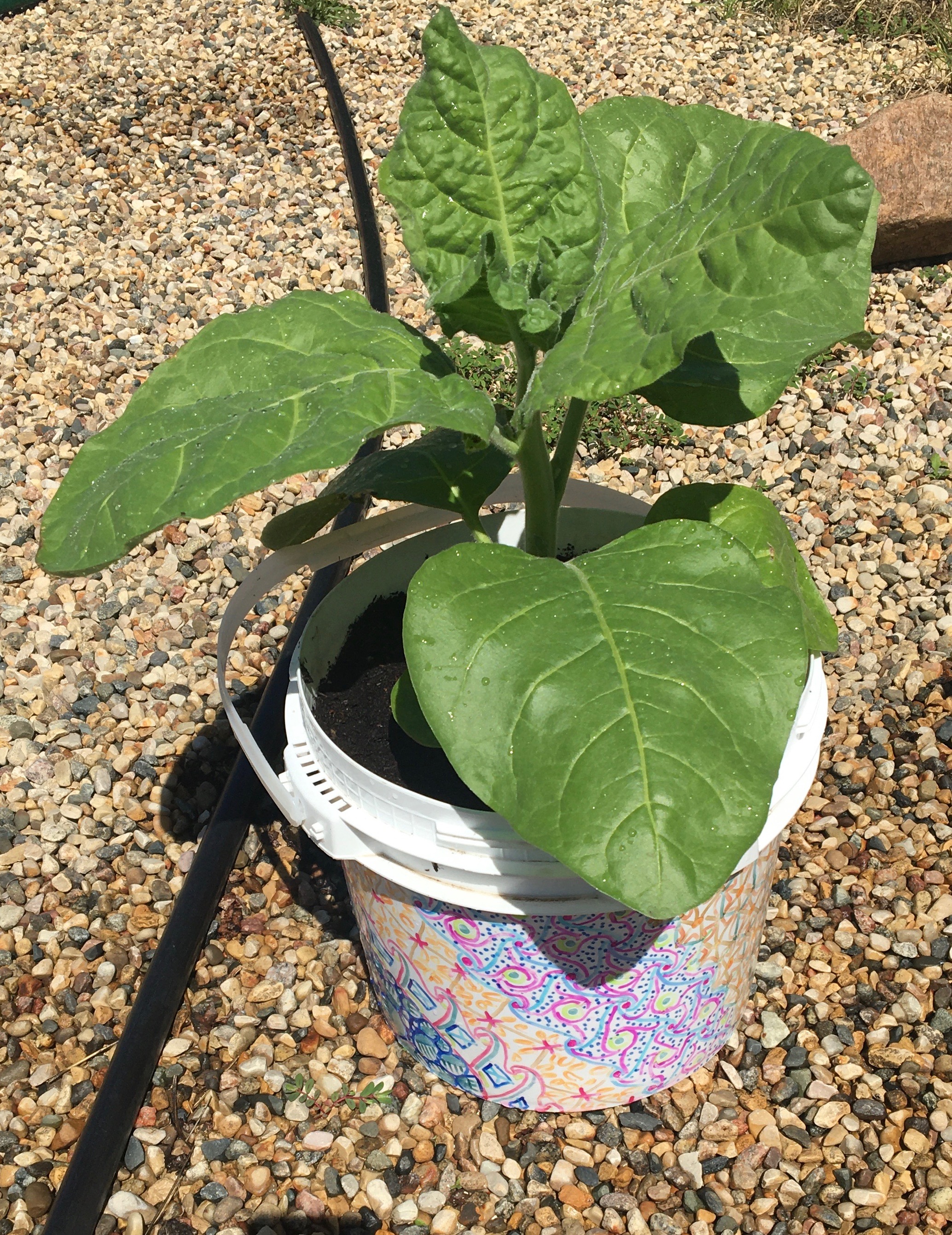
Tobacco is given as an offering of reciprocity before gathering plants. For example, before stripping the bark from a tree, an expression of apology and thanks is given and the tobacco is offered (Hughes, p. 53).
References
Collishaw, N. (2009). History of tobacco control in Canada. Physicians for a Smoke-Free Canada, Ottawa. Retrieved from http://www.smoke-free.ca/pdf_1/2009/History%20of%20tobacco%20control%20in%20Canada.pdf (Accessed June 2020)
Hughes, J. D. (1987). American Indian Ecology. Texas, USA: Texas Western Press, The University of Texas at El Paso.
"Wild Tobacco". (n.d.) Retrieved from University of Alberta Indigenous Teaching & Learning Gardens website: https://sites.google.com/a/ualberta.ca/our-garden/our-plants/wild-tobacco